FRANCE / ECONOMIC-POLITICAL ANALYSIS

The FrenchParadox

Economic Equality Trapped in Top-Down Governance.

It is experienced by the People - i.e. grassroots - as a direct political pillaging.

Nominal Gini vs. Purchasing Power Gini — The Consequence: Invisible Growth in Inequality ↓

  • The Economic Axis (Socialism Degree ≥ 50%): Measured by disposable income after tax, France maintains an official Gini index of around 30–32%. Since this remains below the critical 35% threshold, France technically possesses an economic grassroots democracy. Its extensive welfare and tax systems successfully compress material inequality, keeping the country on the economically flat, socialist side of the map.

  • The Political Axis (High Power Concentration): Despite this economic equality, France completely lacks the political-administrative component required for a real democracy or anarchy. The country is a hyper-centralized republic ruled top-down from Paris, characterized by an overwhelmingly strong executive presidency and an impenetrable technocracy.

  • Measuring the Power Elite: This extreme vertical organization and concentration of authority results in a very high RDI (Rangsdifferanse-indeks / Rank-Difference Index). The RDI values, estimated empirically by IIFOR and NØI-INDECO-OSE, confirm a massively top-heavy political pyramid that leaves the grassroots with minimal real influence over governance.

Systemic Failure and Civil Unrest:

This structural imbalance creates an explosive systemic failure. The French public pays some of the highest taxes in the world to sustain an economically egalitarian society, yet they wield no democratic control over how the centralized state budget is managed. When the ruling elite uses its high RDI to bypass public consensus and force through unpopular structural reforms, it is experienced by the People - i.e. grassroots - as a direct political pillaging. The massive, ongoing demonstrations in France are a direct reaction to this profound friction between functional economic equality and a severe deficit in political autonomy. It is clearly statist.
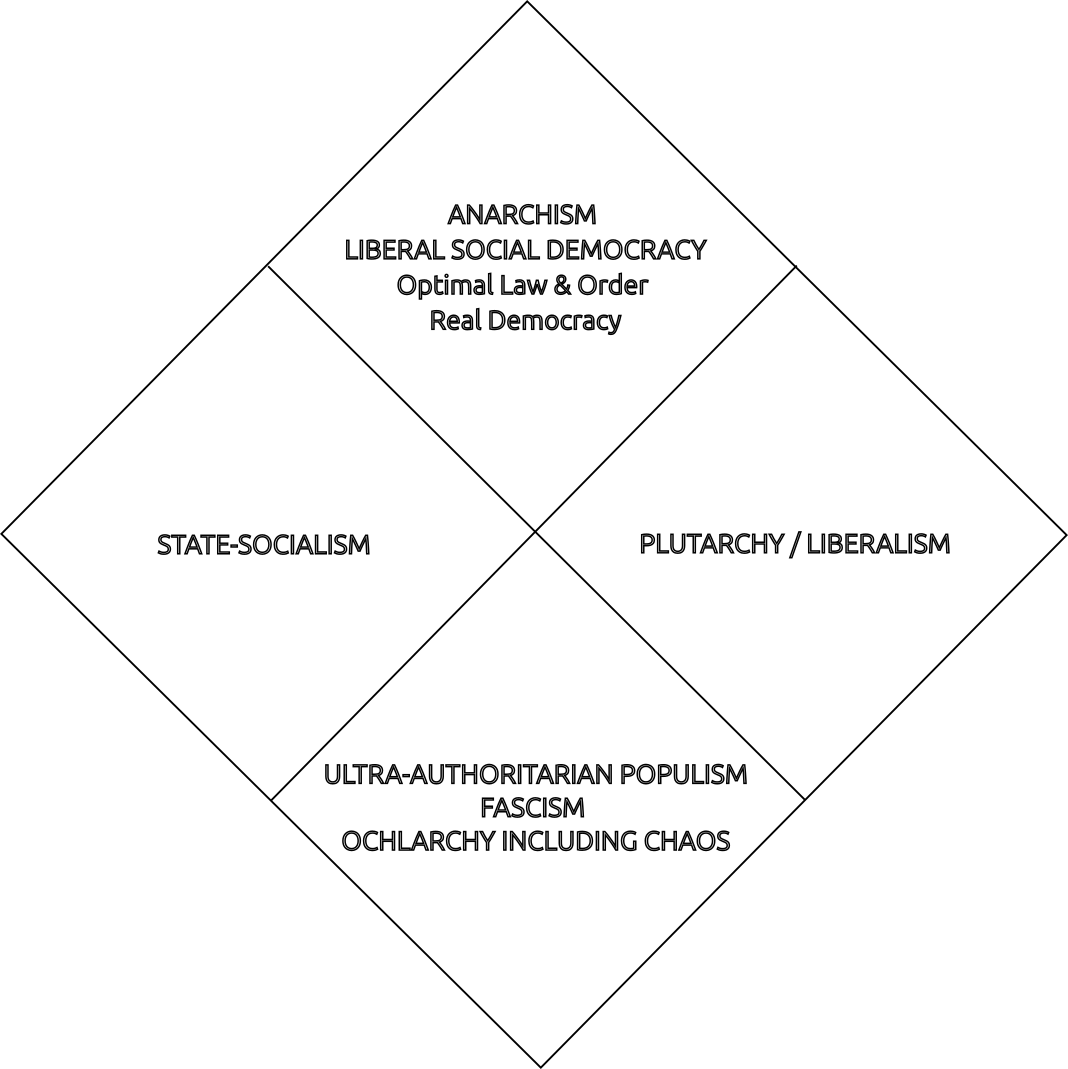
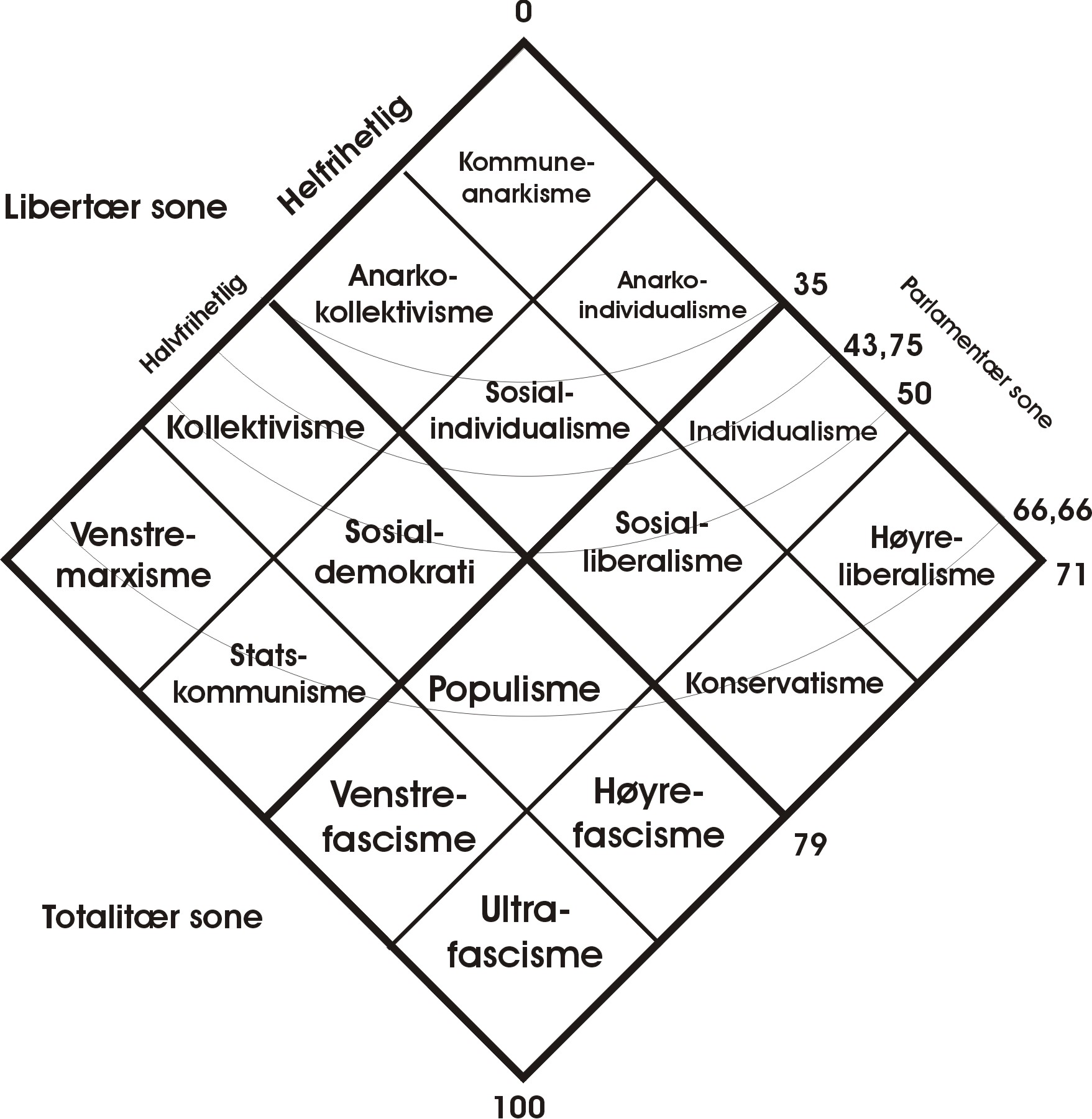
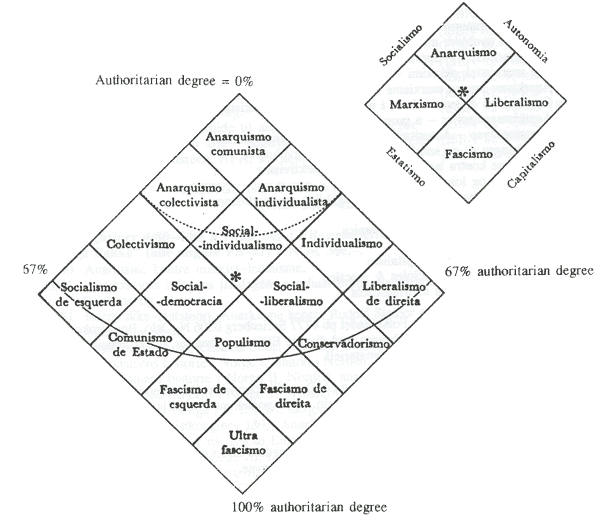
Anarchist Economic-Political Map — map.pngAnarchist Economic-Political Map — epmap.jpgAnarchist Economic-Political Map — epwm2.gif

*) The stars indicate the position of the Norwegian economical-political system after the revolutionary change in 1994/95.

Fig. 1. Picture of the Anarchist Economic-Political Map

A mathematical precisation of the map is presented at the Formula of anarchism.
For practical statistical methods of estimation of the authoritarian degree etc. see the chapter V. B. at Economic-political Map.
NB! We usually have used " , ", the European standard instead of American/UK standard, i.e. " . " as decimal separator. The term "ca" is an abbreviation for the latin circa, which means about or approximately.
We use the term semi-libertarian for all systems that are not totalitarian and are not anarchist.

Interactive Economic-Political Map

Nominal Gini vs.Purchasing Power GiniThe Consequence: Invisible Growth in Inequality.

Therefore, in all likelihood, there has also been an economic "Robbery of the People" in France.

Nominal Gini vs. Purchasing Power Gini

The official Gini index often shows stable inequality even when ordinary households are experiencing a deep purchasing power crisis. This paradox is caused by a methodological flaw: the index only measures the annual nominal disposable income (cash in hand before consumption) and completely ignores what those money can actually buy over time.

To uncover the real inequalities in disposable real income, we must differentiate between the consumption patterns and Consumer Price Indexes (CPI) of the two distinct groups in society:

  • The People's CPI (The Grassroots): Ordinary households spend the vast majority of their income on essential goods such as food, electricity, mortgages, and fuel. These basic necessities are precisely the items that have experienced the most aggressive price increases.

  • The Authorities' CPI (The Elite): High-income groups spend a negligible fraction of their budget on basic necessities. The remainder is funneled into savings, investments, and luxury consumption, where price hikes do not threaten daily livelihood.

The Consequence: Invisible Growth in Inequality

When statistical bureaus use a single, shared average CPI for the entire population, reality is masked. Even if the nominal Gini index remains perfectly constant, the purchasing power Gini index will increase significantly when the People's CPI rises faster than the Elite's CPI. The value of the money at the bottom of society erodes, while the money at the top retains its real purchasing power.

Measuring inequality using nominal figures during times of high inflation acts as a smoke screen. In order to assess the true socioeconomic differences in living conditions, it is methodologically mandatory to use purchasing power Gini indexes that adjust incomes against group-specific price indexes. Therefore, in all likelihood, there has also been an economic "Robbery of the People" in France.

For more information about "The Great People-Heist"—which is, in all likelihood, taking place throughout Europe and North America—see (click on): https://www.anarchy.no/ssbfeil.html.


From: https://www.anarchy.no/iwwfrance.html. Click on and read all, including the material on the links.